Monday, February 9, 2015

Why We Ask: What Do You Do?

Rabbi Efrem Goldberg recently wrote a thoughtful post entitled "Don’t Confuse Earning a Living with Living", in which he relates a story about an encounter he had with a stranger sitting at a wedding.
At the meal, I found myself sitting at a table of people I had never met.  In an attempt to be friendly to the man seated next to me, I asked him, “What do you do?”  He sat up in his chair, turned to me and said, “What do I do, or how do I earn a living?  I earn a living as a plumber.  What I do, what I am most proud of, is that I learn Torah every morning before davening, and I spend time with my family every evening after work.”  His answer remains etched in my memory as he taught me a profound lesson that day in that short, but poignant answer to my simple social question.
Culturally, at least in the United States, "What do you do?" is the first thing you ask to someone that you don't know. It's an ice-breaker; a way to start a conversation. Tell me about yourself. Yet, after I made aliyah, I noticed that Israelis almost never ask this question. They ask different questions: "Where are you from?" "Where did you serve in the army?" To Anglos (like me), they'll often ask, "You're from America, right?" (It's a game where they try and identify you from your accent. It's not hard.) But they don't usually first ask about your profession. That got me thinking about the differences between cultures and countries, and wondering why people in the States ask about and identify a person through his or her profession. I think, at least subconsciously, "What do you do?" is also a question about money and social status. When you ask, "What do you do?" you're also asking another question: "How much do you earn?" Because if you're a lawyer or a doctor, I can place you in one social sphere. If you're a plumber, you're in another; a teacher or social worker? Yet another. (When they asked me the question and I told them that I was the rabbi of a shul, people would inevitably ask me the obvious follow-up: "Really? How many families?" It's the same question: Are you the rabbi of some small shtiebel, or are you an "imporant" rabbi of a significant community?) We assess people by their earning power, and extend to them social status commensurate to that financial wherewithal. It's sad, but too often true. Think about the shul you attend: how do people relate to the doctors, compared to how they relate to the physical therapists? It's not a question of how many aliyot a person gets, but a question of voice, deference, and communal authority. In Israel, people earn far less money, and doctors and lawyers don't really earn much more than teachers (which is one reason why it's so hard for American doctors to make aliyah). There are very few truly rich people, at least where I live (to the best of my knowledge). I have no clue how much people do or don't earn. This type of subconscious assessment is only natural. The people with greater means do get a greater say. We need them - at least externally - more than we do everyone else. Their donations keep the lights on; they pay for the kiddushim we enjoy, and for the rabbis' salaries as well. We have to give them a voice, especially in the decisions of the institutions that they support. Yet, this unspoken preferential treatment alienates those who don't fit the bill: the teachers, the marketers, the plumbers (although plumbers do fine, from what I hear).
I'm sure that Rabbi Goldberg meant none of this when he asked the plumber "What do you do?" Yet, in some part of his mind, I'm also sure that the plumber heard a different question: "Hello. I don't know you. Are you an important person? Does your profession make you someone I should respect?" To this question, instead of answering, "Actually, I earn a living wage by putting my hands in people's waste all day long," he chose a different path - an understandable one from that point of view. I wonder whether the plumber would have had the same reaction had his chosen profession been to own a chain of plumbers which served six states. Perhaps yes, although I doubt he would have reacted so sharply to the question.
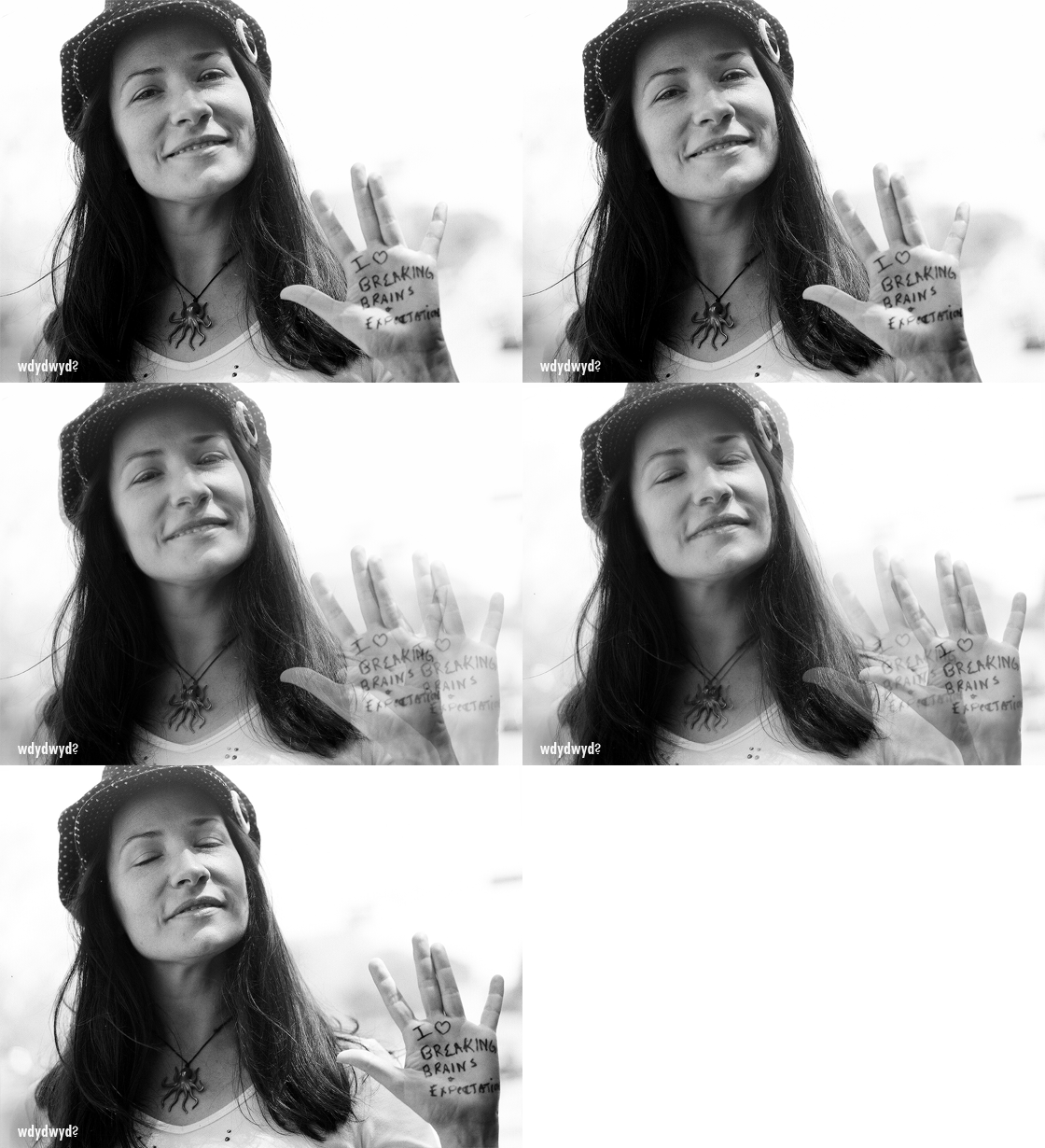
Throughout the school year at Orot, we invite groups of young women serving in Sherut Leumi (National Service) for in-service days (yemei iyyun). Often, I give a seminar called "Finding the 'Me' Among the Masses" (מצאית ה"אני" בתוך ההמונים), in which we speak about balancing the need to actualize our individuality with the needs of the community and the country. I always begin this seminar by doing an exercise called "Why Do You Do What You Do?" (or WDYDWYD), a seminar that's given in business and school settings around the world. I do a little exercise where I ask the students to spend five minutes drawing a picture that explains "Why they do what they do." 
It's harder than you think, because before you can answer the question "why", you first have to ask yourself, "What do I do?" - a question that can be as narrow as "Why am I sitting in this room?" and as broad as "Why am I serving in Sherut Leumi?" It's always an incredible exercise.
Each time I give the seminar, I also draw a picture. During the first years after our Aliyah, I always drew a picture of my family. I interpreted the question to mean, "Why are you giving this seminar in Orot today? Why did you leave the rabbinate and make Aliyah?" The answer, to me, was always for the sake of my family and my children. Yet, each time I drew that picture, it forced me to ask other questions: If I really am doing it all for my kids, why don't I spend more time with them? (This actually prompted me to take a day off from work and take them on a tiyyul.)
Perhaps the question we should ask people when we meet them for the first time isn't "What do you do?", but instead, "Why do you do what you do?" 
That question would lead to a much more fruitful and interesting conversation.

Monday, February 2, 2015

Orot Students Enjoy Intensive Practical Field Work Week

Racheli Bartuv
Field Work Coordinator, Elkana Campus


Orot Israel College considers practical field work to be an intrinsic part of the curriculum. Thus, our students recently spent an intensive week applying much of the theoretical knowledge they had acquired in the classroom and discovering how the educational system functions in the real world.
Inter alia, they were given a firsthand look at many of the educational challenges and projects that face teachers and educators in the school system. The Orot students observed lessons, participated in peer discussion groups, and even ran various activities in different schools about midot, the plants and animals of northern Israel, Chanukah, and other topics. In addition, some Orot students participated in various workshops organized by the Pedagogic Center, including: combining film clips and graphic elements into a single presentation; assorted ways to begin a lesson; decorating the classroom setting; and preparing a dynamic learning center about shmitah.
During the course of the week, many of Orot’s individual departments also organized trips and outings for their students. For instance, the school guidance and the social-communal education departments visited the Retorno Rehabilitation Center; the Toshb”a department toured the Rambam Library; the communication and mathematics departments visited the Amit Amichai School in Rechovot; and the early childhood education department explored Petach Tikva’s unique Gan HaSfarim. Coincidentally, the education minister happened to be visiting a certain school that same week, and the Orot students enjoyed watching how the excited faculty and students prepared for his visit.

Orot Students Attend “The Wave”

by Dr. Vitela Arzi 
Head, English Department, Orot Israel College


Ideally, when studying a foreign language, one should also be exposed to authentic culture – specifically, art and literature - in that language. Thus, students in Orot Israel College’s English department not only study English poetry, literature, and drama, but when the rare opportunity presents itself, they also get to experience original English-language theater in Israel.
For instance, during the month of MarCheshvan, ADGE, an acclaimed British-American professional theater group largely known for its Shakespearean productions, brought its adaptation of Todd Strasser’s “The Wave” to Israel. Based on a real-life incident, “The Wave” is set in California in the 1960s and tells the story of a high school history teacher who conducts a shocking experiment to teach his class about the rise of Nazism. The teacher tries to show his students that even “enlightened” American teenagers can easily succumb to the lure of a fascist ideology.
ADGE has appeared in countries around the world. Its goal is to introduce classic drama to young English students in order to improve their English language skills.
Orot Israel College’s administration supports and encourages extracurricular cultural enrichment activities. Thanks to the academic dean, Rav Dr. Moshe Rachimi, Orot funded the tickets and provided transportation to the play, and a large group of first- through third-year students took advantage of the offer and traveled to the theater in Kfar Saba. The outing proved to be a huge success.
First-year Orot student Aviva Balta said, “I really enjoyed the play. I’m glad you thought of it. This was also a wonderful way to improve our English, and as you always say, ‘language is also culture.’ And I think we were privileged to learn about a culture that is different from ours in a creative way. It’s possible, of course, to learn from books, but the play simply brought it all to life. It was amazing! In the play, we were able to see English-speakers’ mentality and what is emphasized in their culture (like football, etc.). The play was on a high level, and the actors weren’t indifferent to the audience. They included us, and we basically played a part in the show. I think this experience is very important for English students, and for me personally, it even inspired me to work harder at my studies.”
Kinneret Shteinmetz, a teacher taking courses at Orot, touched upon the play’s connection to recent events. “This week, we had the rare opportunity of seeing a quality play in English,” she noted. “The play focused on an attempt at understanding how humans can lose their critical and independent thinking and act as a mob – as exemplified by the Nazi party during World War II.
“We saw the play several hours after the deadly terror attack in the shul in Har Nof, where four Jews were murdered while still wrapped in their talitot. It is impossible not to be aware - these days, in light of the difficult images – of the parallels to World War II. Now, once again but with even greater intensity, the question that was brilliantly and professionally presented on the stage arises: How incitement and brainwashing can be dangerous and can lead people to hateful acts that they would not have done otherwise.”
Like other extracurricular cultural activities, theater is a manifestation of the holistic approach to the educational experience in general and to studying a foreign language in particular that is endorsed and espoused by Orot Israel College and its English department.

Fastforward 23 years....Orot Bat Zion 5753 Reunites in Modi'in

Judy (Beigel) Silkoff – BZ 5753/1992-3
A google search of the word ‘reunion’ brings up three official definitions; the first two refer to a gathering of old school friends, and the third to unification of a country. But it is that third definition, “the action of being brought together again as a unified whole”, that seemed to most aptly describe the Orot reunion my Bat Zion programme organised in Modi'in in January.
The idea for the reunion came about as a direct result of the get-together organized by Nomi Spanglet in Elkana last year. Green with envy that I couldn't make the trip from London to join everyone in what we used to fondly refer to as the ‘yellow michlala’, my dear friend and Orot roomie Jacqueline promised me that she would sort one out for me next time I was in Israel. And she didn't disappoint!
Thanks to the help of Nomi and of course, Facebook, it wasn't too difficult to track down everyone in our year (1992-3/5753). Turns out that out of a group of 51 girls, close to 30 are now living in Israel! And 18 of them (plus Nomi, myself, and Amy who was visiting from Toronto) gathered in Jacqueline's beautiful home on January 6th to catch up, reconnect, share photos and rekindle memories of some of the best times of our lives. The years seemed to melt away and there was so much noise, laughter, happy tears and emotion in the room. 23 years ago we came to Orot as a group of strangers but over the ensuing months we bonded in only the way Orot girls could! We may all be living very different lives now, but the strong beliefs and feelings that connected us then still hold us together – and although we didn't quite get to breaking out into song, I could definitely hear the faint strains of all those chug Shira sessions echoing in the background!

Sunday, December 14, 2014

Hallel on Chanukah: Praising God Despite the Darkness

by Rabbi Reuven Spolter
Jewish Studies Lecturer

What would happen if this week, leading politicians from across the political and religious spectrum in Israel declared a new national holiday for our victory over terrorism? How would we react? I imagine that we would be at least somewhat perplexed. Celebrate? This week? Isn’t it just a little bit early? For all of our efforts this past summer, Hamas seems determined to proclaim its great hatred and wish to annihilated us. Iran is lurking in the background, and even our friends celebrate terrorists as martyrs. It's hardly a time to celebrate. Yet, this is exactly what the Jewish people do during the Chanukah war. The conquest of Jerusalem and the re-dedication of the Beit Hamikdash by no means signaled the end of the war against the Greeks. In fact, the war dragged on for at least another two years, and the hero of our story, Judah the Maccabee, died in a subsequent battle against the Greek army. One can easily wonder: how could they celebrate? OK – rededicate the Beit Hamikdash  and quietly begin the sacrifices again. That much we can see. But why not establish Chanukah at the end of the war, when everyone can enjoy the peace and prosperity that peace finally brings? The answer to this difficult question lies in the words of Hallel that we say throughout Chanukah, words that reflect an important Jewish value that we must keep in our minds, especially during such difficult and trying times. When we examine the chapters in Tehillim that comprise Hallel, at face value, several sections don't seem like much of a Hallel at all. What’s supposed to be praise turns out to be rather depressing. Yes, there’s the הודו לה' כי טוב – we do praise God for the good, and declare His greatness and goodness to us. But then there are entire chapters that are not so positive, that really must make us wonder what they’re doing in הלל.
אפפוני חבלי מות ומצרי שאול מצאוני – the pains of death encircle me, the confines of the grave have found me; אתהלך לפני ה' בארצות החיים: I will walk before God in the lands of the living האמנתי כי אדבר אני עניתי מאד: I have faith even though I say, “I have suffered greatly.”
How is this הלל? Why are these words of praise and thanks to God? During my first year of study in Israel at Yeshivat Sha’alvim, I learned what הלל is really all about. On יום הזכרון, Israel’s Remembrance Day for fallen soldiers, Rav David Kimchi, then a Madrich at the yeshiva who had fought in Lebanon in מלחמת שלום הגליל – the (first) War for Peace in Galilee in the 1980’s, spoke to the American students. He described the terror of battle and the randomness of war. You simply didn't know who would live and who would not. After surviving a tank battle, he explained how the paragraph of מה אשיב came to have special meaning to him:
מה אשיב לה – how can I repay God for all his kindness to me – for saving me from the chaos and horror of battle? נדרי לה' אשלם – I will repay my vows to God. What vows? What does King David mean? Rav Kimchi explained that when you’re in battle, in a tank – and things aren't going well, you’re scared – terrified, and cry out to God for salvation. So you make נדרים: “God, if you get me out of this alive, I promise to learn this many pages of Gemara; to do this many מצוות.” So, when we are delivered, we must keep our vows. Finally, David says, יקר בעיני ה' המותה לחסידיו – “Precious in the eyes of God is the death of his devout ones.” Everyone, said Rav Kimchi, lost a friend, a platoon member, and family member. Those are the חסידים – the devout ones who give their lives for the Jewish people. 
This is the Hallel of King David. He says praise and dedicates himself to God not when things are wonderful and happy. Rather, he says Hallel when the pain of war still burns freshly in his mind – when the smell of the battle and the vivid and painful images fill his head. It is at that time that King David says: Yes, I have suffered – BUT. Yes, I feel pain – BUT. But, I must still give thanks to God. But, I must still say הודו לה' כי טוב – and give praise to God, for all the good that I still enjoy. Yes, BUT. There must be a but, and we must continue to say הלל, because we must also see the positive side of the picture, and appreciate what we take for granted in today’s day and age.

This past year has been more challenging than years past. We endured a challenging war which placed many Israelis - citizens and soldiers - in the line of fire. We have witnessed a resurgence of terrorism that once again strikes, seemingly at random, leaving horror and dread in its wake. And still we say Hallel and give praise, because we have so much for which we must be thankful.

When we read the history of the Chanukah revolt, historians teach us that one of the most perplexing aspects of the entire Chanukah story is Antiochus himself. After suffering a humiliating defeat in Egypt, Antiochus returns to Jerusalem to reassert his authority on the Holy Land. Yet, in a real sense he is already in control. He has no real need to rule with an iron fist, but for some reason he does. Repudiating the Greek policy dating back to Alexander the Greek to let the local culture maintain its own religious practice, Antiochus decides that he’s going to get rid of Judaism. And he does try, although to this day, no one really knows exactly why.

Upon his return to Judea, the Book of the Maccabees tells us that he and his army massacre Jerusalem, murdering 40,000 people, and selling another 40,000 into slavery. One cannot imagine today what would happen to the Jewish people were we not in control of the Land of Israel. Let’s not kid ourselves: we know how our enemies about us. There would be no worldwide outcry if an Ayatolla turned himself into another Antiochus. He’d love the opportunity. But this time things are different. Finally, for the first time in Jewish history since Chanukah, we can protect ourselves. We can, and we do. And for this, even during our suffering, we must say Hallel.

The lighting of the Menorah does not signify the end of the war by any means. Yet, the people during those times are able to see יד ה' – and to rededicate themselves to their traditions and their teachings. They’re able to pick up and go on – and not focus on the terrible suffering that they have endured, and continue to endure at the hands of the Greek army. So too we must do the same: to cry for those we lose, but to never lose sight of the יד ה', and never to forget the goodness that we enjoy and can never take for granted.

Even while we say יקר המותה לחסידיו – “Precious in the eyes of God is the death of his devout ones” – we must still say, הודו לה' כי טוב, and forever remember the goodness and blessing and strength that God gives the Jewish people today.

Tuesday, November 25, 2014

What Does Elkana’s Senior Citizen Center Have to Do with Orot Israel College?

by Mrs. Tzvia Mintzer 
Head, Gil HaZahav Association, Elkana
Shalom lachem.
My name is Tzvia Mintzer, and I am the founding chairwoman of Elkana’s Gil HaZahav Association.
About five years ago, recognizing that the number of senior citizens here in Elkana continues to increase every year, we - the community’s older members - decided to establish a non-profit organization that would provide services for us in our old age. Our goal was to offer recreational and cultural activities in order to improve local senior citizens’ quality of life and to transform Elkana into a wonderful place to live – even for the elderly.
You’re probably wondering what Elkana’s senior citizen center has to do with Orot Israel College, which trains a generation of young teachers and educators in various subjects?!
Here’s my answer:
1. Elkana’s veteran residents have a longstanding, warm relationship with Orot Israel College. We value and appreciate Orot’s positive impact on the community and its older and younger residents.
2. We all wish to continue to maintain this rich bond, to continue to give and receive, and to continue to grow and develop together.
Elkana’s veteran residents have a deep emotional bond with Orot. They have been working together with Orot from its establishment and founding by its first president – a longtime resident of Elkana – our friend, Rav Dr. Yehuda Felix, and through its further physical and spiritual development by Rav Professor Neria Guttel.
Many of our friends in Elkana worked and still work for Orot in various positions. The community and its residents feel very close to Orot. We share many values with Orot, its administration, and its faculty, and we admire its academic achievements. Indeed, many of us – especially the veteran residents – consider Orot to be our home. A number of older Elkana residents studied at Orot and taught there, and now their grandchildren are following in their footsteps.
Meanwhile, Elkana serves as a warm home for the Orot students who live in the dormitories. Often, they meet their future husbands in Elkana, make their homes in the community, and accept teaching positions at one of Elkana’s various educational institutions.
Thus, when we decided to open our senior citizen center but lacked both a permanent location and technological resources, we did not hesitate to turn to Orot Israel College for help. And in fact, to our delight, Orot responded willingly and graciously to our request. Over the past four and a half years, leading members of Orot’s faculty delivered lectures at our center; we launched an intergenerational program with Orot’s students; communication students interview the seniors, who share their life stories; a Daf Yomi class is broadcast to the seniors on the local radio station; students give lectures at the center; and we attended computer courses at Orot and learned how to join the digital world. We are also extremely grateful for the use of Orot’s auditorium as a venue for many of our experiential and joyful events.
In the future, we hope to open a regional educational center on campus for the senior citizens of Elkana and the Shomron. This initiative will not only strengthen Orot’s ties with the area’s veteran residents but will also strengthen Orot’s regional and national stature. Orot Israel College’s administration has already approved the plan in principle, but due to a number of factors, we are not yet ready to begin this project.
I wish to take this opportunity to thank Orot Israel College and Rav Professor Neria Guttel for all their help and cooperation, and I look forward to watching our relationship grow ever stronger.

Israel’s Chief Rabbi Visits Orot Israel College

Several days before Rosh Hashanah 5775, the Chief Rabbi of Israel, Rav David Lau shlit”a, visited Orot Israel College. Rav Professor Neria Guttel, Orot’s president, and Rabbanit Dr. Lea Vizel, Orot’s dean of students and dean of extramural studies, welcomed the honored guest, and hundreds of Orot students crammed into the packed auditorium to hear him speak. Rav Lau’s talk was divided into two parts: an inspiring shiur about Rosh Hashanah and a question and answer session.

Rachmana Liba Ba’i
Rav Lau began with a focus on prayer. He noted that the Torah readings for the two days of Rosh Hashanah are the story of Yishmael’s banishment and Akeidat Yitzchak respectively. The latter selection makes sense, but the former is hard to understand. Moreover, the episode appears to convey two contradictory messages: On one hand, we learn that “one who prays for his fellow is answered first.” (Sarah’s prayers are answered after Avraham prays for the people of Grar.) But on the other hand, we see that highest precedence is given to a sick person’s own prayers, as manifested by Yishmael’s prayers:
"וישמע אלוקים את קול הנער."
“And God listened to the voice of the youth.” (Breishit 21:17)
(Similarly, Yeshaya informs Chizkiyahu that he will die, but after Chizkiyahu prays for himself, he is granted an additional fifteen years. See Melachim II 20:1.)
In order to clarify this seeming contradiction, Rav Lau explained that it depends on the specific person, the specific prayer, and the specific circumstances. In certain situations, it is best for a person to pray for himself, but in other situations, the prayer is more effective when someone else prays. The key is that the prayer must be heartfelt, because one who prays from the depths of his heart finds that his prayers are answered. Yet, Rav Lau continued, in order for one’s prayers to be answered, one must cry out to Hashem “with sincerity,” as suggested by the pasuk:
"קרוב ה' לכל קוראיו לכל אשר יקראוהו באמת."
“Hashem is near to all who call Him; to all who call Him with sincerity.” (Tehilim 145:18)

Shmitah Challenges: A Gardening “Scoop”!
At Rav Professor Guttel’s request, Rav Lau graciously agreed to respond to several of the students’ questions. Unsurprisingly, since Rav Lau’s visit to Orot occurred just a few days before the onset of the Shmitah year, one of the students asked about the Chief Rabbinate’s policies and approaches to the various halachic mechanisms for observing shmitah. Rav Lau treated the audience to an exhaustive discussion of the topic. He began by explaining the differences between the various options: heter mechirah, otzar beit din, matza menutak (i.e. produce grown on platforms and in hothouses), produce grown in the sixth year, and produce grown by non-Jews in Israel and abroad. The Chief Rabbinate’s policy is to supply each population sector with the solution that best meets its worldview – as long as everything is done in accordance with Jewish law.
For instance, the heter mechirah (a complex halachic mechanism whereby the land is sold to a non-Jew) continues to be a vital necessity. With all due respect to those who refrain from working the land – and considerable credit goes to the farmers who follow the beit din’s directives (i.e. otzar beit din) – we cannot ignore the fact that the majority of the country’s farmers, like the majority of the country’s citizens/consumers, are what are euphemistically known as “wearers of transparent kippot.” Thus, from the State’s point of view, the heter mechirah is not only necessary for this year but all the more so for the years to come – in terms of holding on to agricultural fields; retaining control of export markets, both during this year and the following years; and even as a source of income. We cannot turn these farmers into lawbreakers; the State needs these crops too. And clearly, after leading Torah giants throughout the generations (albeit not all of them) endorsed and supported the heter mechirah, its validity is certainly not in question.
Rav Lau half-jokingly – yet correctly – pointed out that while the mitzvah of ahavat chinam (gratuitous love) and the sin of sinat chinam (gratuitous hatred) are both d’orayta (from the Torah), shmitah is only d’rabbanan (rabbinic) in our time… It is very easy for us to criticize others and to point out their shortcomings and the flaws inherent in their solutions, but we tend to avoid doing the same for ourselves. Every individual and every community should focus on their own worldviews and solutions and live their lives accordingly – while acknowledging that other people’s approaches are also legitimate and halachically valid.
During the course of his talk, Rav Lau revealed a fascinating “scoop” about the current shmitah year. As a rule, the heter mechirah does not apply to ginot no’i (“ornamental” gardens) – whether private or public. One is only permitted to do that which is strictly necessary to maintain the garden, and nothing else. This has always been the case – even for those who support the heter mechirah. However, lo and behold, in 5775, for the first and only time since the heter mechirah was instituted, the Chief Rabbinate ruled that there is a specific situation where landscaping is permitted – on an exclusive, one-time basis.
The case in question is Bahadim City, the new IDF Training Campus currently under construction in the Negev. Many military bases will be relocating to the massive site, and as such, it is considered to be a top national priority and an extremely costly one at that. Now it turns out that as part of the tender, the contractor who won the bid is obligated – inter alia – to handle the extensive landscaping. As the shmitah year – and the prohibition against working the land – approached, the contractor said to the army, “No problem. I’m willing to halt the landscaping work and not do the job, but you will owe me. If you breach the contract, you will have to pay me.” Just to be clear: We are talking about millions and millions of shekels, which would be wasted instead of spent on definite security needs.
Rav Lau described how the question was brought before the Chief Rabbinate’s “Shmitah Committee,” which was divided on the issue. Rav Yaakov Ariel was opposed, but the other committee members – Rav Avraham Yosef and Rav David Lau himself – were in favor of permitting the landscaping. Their decision was partially based on the fact that Bahadim City is part of kibush olei Mitzrayim (within the boundaries of the land conquered by Yehoshua after the Exodus from Egypt) but not part of kibush olei Bavel (within the boundaries of the land reconquered by the Jews who returned from Babylonia with Ezra), and thus less complicated from a halachic perspective. In any event, as noted above, the innovative and groundbreaking ruling was a one-time exception – a literal hora’at sha’ah (“an emergency measure”) – and this is the first time it was made public.

The Orot students also asked about other issues – including a significant number of questions about kashrut: What is the difference between the various Badatz hechsherim and the Chief Rabbinate’s hechsher? Can one use powdered milk that is chalav nochri? What should one do when visiting one’s parents who are less stringent about various kashrut issues? In addition, Rav Lau was asked about traveling abroad in general and to Uman in particular and many other questions.

In conclusion, the Chief Rabbi’s visit was memorable and extremely interesting. As he left Orot Israel College, Rav Lau said that he had derived considerable pleasure from the event and from the caliber of the Orot students, and he indicated that he would be very happy to come again.